Electrostatic Adsorption-Driven Reorganization of Phycosphere Eco-Corona as a Toxicity Mechanism of Cationic Nanoplastics
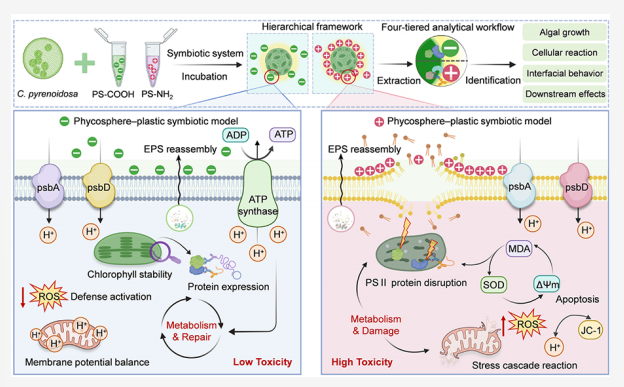
Nanoplastics (NPs) are emerging contaminants in freshwater ecosystems, readily forming heterogeneous aggregates with microalgae, yet their behavior in algal phycospheres remains poorly resolved. Here, we establish an aquatic phycosphere−plastic symbiotic system and a four-tiered analytical workflow, encompassing growth responses, cellular effects, phycosphere dynamics, and proteomic reprogramming to test how surface charge controls interactions between carboxylated and aminated polystyrene NPs (PS-COOH, PS-NH2, 50 nm) and Chlorella pyrenoidosa. Negatively charged PS-COOH exposure largely preserved physiological, ultrastructural, and redox homeostasis, indicating high tolerance of the symbiotic system. In contrast, positively charged PS-NH2 strongly inhibited biomass and chlorophyll, and triggered a cascade of intracellular stress, including sustained reactive oxygen species (ROS) production, lipid peroxidation, antioxidant imbalance, mitochondrial membrane depolarization, and up to 89.6% apoptosis. Three-dimensional excitation−emission fluorescence with parallel factor analysis and self-organizing map (PARAFAC-SOM) analysis revealed charge- and dose-dependent reorganization of tyrosine- and tryptophan-like protein components in tightly and loosely bound extracellular polymeric substances, indicating spatial eco-corona remodeling. Quantitative proteomics showed that PS-COOH mainly induced homeostasis regulation in photosystem and electron-transport proteins, whereas PS-NH2 broadly disrupted photosynthesis, carbon metabolism, and protein homeostasis. This multitier framework links NPs’ surface charge to coupled interfacial, cellular, and proteomic processes in microalgal phycospheres, providing a mechanistic basis to assess the biological footprint of NPs in freshwater ecosystems.